

Puncture of the maxillary sinus in sinusitis
One of the methods of treating sinusitis, in which a special tool is inserted through a small puncture in the wall of the maxillary sinus to remove accumulated pus and relieve inflammation.
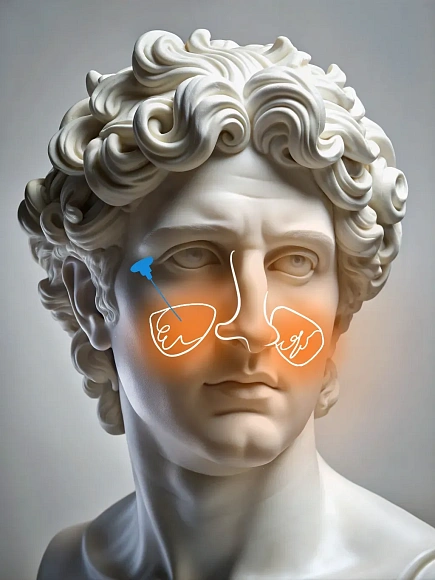
Puncture is used in cases of acute sinusitis, and allows you to quickly clear the purulent focus in the maxillary sinus.
Benefits
Rapid relief of the condition
Patients note ease of breathing and reduction of pain after the procedure.
High efficiency
High-quality treatment of acute and chronic forms of sinusitis.
Minimal intervention
The procedure is less traumatic compared to other surgical treatments for sinusitis.
Monitoring of the treatment process
The possibility of introducing antibiotics and other drugs into the sinus to enhance the effect.
Preparation for puncture of the maxillary sinus in sinusitis
Before the puncture, the patient may undergo a number of diagnostic procedures, including X-rays or CT scans of the sinuses, to determine the localization of inflammation.

Maxillary sinus puncture procedure for sinusitis
The procedure is performed under local anesthesia. The doctor makes a small puncture and inserts through it a special instrument with a curved end on one side and a cannula on the other. A syringe is attached to the cannula of the needle, through which the doctor pumps out the pus.
Recommendations after puncture of the maxillary sinus in sinusitis
After the puncture, it is important to follow all the doctor's recommendations, including taking antibiotics and anti-inflammatory drugs, as well as rinsing the nasal passages with saline solutions.

Врачи
Смотреть всех врачейIndications and contraindications
Indications
Acute or chronic sinusitis
Especially in the presence of purulent exudate and ineffectiveness of conservative treatment.
Complicated course of sinusitis
As a means of preventing the spread of infection to neighboring organs and tissues.
Expected effect
Elimination of purulent contents
Removing pus from the sinus reduces inflammation and improves the patient's well-being.
Restoration of sinus drainage
Provides normalization of the outflow of secretions, preventing its accumulation.
Pain reduction
Reducing the pressure in the sinus leads to relief from discomfort.
Prevention of complications
Prevents the development of more serious conditions associated with the spread of infection.
Similar referral activities
Anemia of the nasal cavity
Medical manipulation aimed at reducing blood flow in the nasal mucosa to reduce swelling and facilitate breathing.
Administration of drugs into the nasal cavity
One of the treatment methods that allows direct delivery of medicinal substances into the nasal cavity to combat infections, inflammation, allergies and other diseases of the nose and nasopharynx.
Opening of purulent formations
A procedure to ensure drainage of the infected area to alleviate symptoms and prevent the spread of infection.
Coagulation of vessels of the Kisselbach zone
A highly effective medical procedure designed to treat chronic nosebleeds caused by vascular damage in this area.
Consultation of Otorinolaryngologist
Прием ЛОР-врача, направленный на диагностику, лечение и профилактику заболеваний уха, горла и носа.
Complex treatment of patients with polypose rhinosinusitis
Are you experiencing ear, throat or nose issues? We understand how important it is to hear, breathe and speak properly, so we offer the latest diagnostics and treatment methods.
News & Media
Today, this day is dedicated all over the world to the phenomenon of the human voice and taking care of the health of the vocal apparatus.
Can sealing the mouth lead to suffocation? What other dangers might arise? The answers to these and other questions are waiting for you in the article.
Drug-induced rhinitis (as a form of vasomotor rhinitis) is a non-specific inflammation of the nasal mucosa due to excessive use of vasoconstrictor drugs containing xylometazoline, oxymetazoline, phenylephrine or naphazoline.
Walking in windy weather, getting water in your ear while swimming, or ARVI can cause ear pain. It is not always possible to immediately consult a doctor, and it is not easy to tolerate ear pain, especially when it is acute. In the article we will tell you about ear diseases and how to treat them.
One of the common reasons for visiting an otorhinolaryngologist is problems with nasal breathing. In this article, we will tell you what to do if your sense of smell has decreased, how to relieve nasal congestion and when to visit a doctor.
Pain can be felt when talking, laughing, swallowing, or even at rest. It is important to start treatment immediately, not to tolerate discomfort, so as not to start the disease and quickly get in shape. Ideally, take a sick leave to give the body time to recover and not infect colleagues. In the article we will tell you how to treat a sore throat.
How to reach


- Route from exit 4 of the «Belorusskaya» metro station
- Route from exit 2 of the «Belorusskaya» metro station
How to get
From the Belorusskaya metro station of the Zamoskvoretskaya line - exit 4 After exiting the subway, walk through the pedestrian tunnel and climb the stairs. Move towards the railway tracks, go down the stairs immediately after them and walk along the house, then turn right onto 1st Yamskoye Pole Street. At the turn to 3rd Yamsky Pole Street, cross the road at the pedestrian crossing and continue along 1st Yamsky Field Street, after a few buildings on the left you will see Olympus Clinic MARS.
Travel time
9 minutes
Landmark
Olympus Clinic MARS sign
How to get
From the Belorusskaya metro station of the Ring line - exit 2. After exiting the subway, turn left and walk to the pedestrian crossing. Cross the road through two pedestrian crossings and move along the Tverskoy overpass. Go down the stairs immediately after the railway tracks, walk along the house, then turn right onto 1st Yamskoye Pole Street. At the turn to 3rd Yamsky Pole Street, cross the road at the pedestrian crossing and continue along 1st Yamsky Field Street, after a few buildings on the left you will see Olympus Clinic MARS
Travel time
11 minutes
Landmark
Olympus Clinic MARS sign
Parking lot map
Exit 3 from the metro and 640 meters straight ahead, the clinic will be on the right. Landmark - sign Olymp Clinic
- Route from the «Sukharevskaya» metro station
- Route from the «Tsvetnoy Boulevard» metro station
From the metro station "Tsvetnoy Bulvar"
1 exit to the city, then left to the Garden Ring, at the crossing to the right, crossing the boulevard, one more crossing and at the traffic light to the left. The Olymp Clinic building is located overlooking the Garden Ring to the right of the crossing. Travel time is approximately 9 minutes. Landmark - sign Olymp Clini
From the metro station "Sukharevskaya"
Exit 3 from the metro and 640 meters straight ahead, the clinic will be on the right. Landmark - sign Olymp Clinic
Parking lot map
Exit 3 from the metro and 640 meters straight ahead, the clinic will be on the right. Landmark - sign Olymp Clinic
- The route from the «Airport» metro station
- Route from the «Sokol» metro station
From Sokol metro station
The last car from the center: follow the signs for Exit 5. From the glass doors to the right and go to the end of the passage. Exit to the city by the steps to the left. After exiting the crossing to the street, go straight along Leningradsky Prospekt to the intersection with Chapaevsky Lane. Next, turn right (onto Chapaevsky Lane) and walk to the Triumph Palace residential complex. Entrance to the territory: through checkpoint No. 1, opposite the Vkusville store, you will need to present your passport. After passing through the checkpoint, go up the stairs to the fountain, opposite it you will see our clinic.
Travel time
10-12 minutes
From the Airport metro station
The first car from the center: follow the Exit 2-3 signs. Turn left out of the glass doors and walk to the end of the passage. After exiting the crossing to the street, go straight along Leningradsky Prospekt to the intersection with Chapaevsky Lane. Next, turn left (onto Chapaevsky Lane) and walk to the Triumph Palace residential complex. Entrance to the territory: through checkpoint No. 1, opposite the Vkusville store, you will need to present your passport. After passing through the checkpoint, go up the stairs to the fountain, opposite it you will see our clinic.
Travel time
12-15 minutes
How to get
Entry to the territory is prohibited, but there are free city parking lots around the Triumph Palace residential complex, where you can easily find a place for your car.
- Route from exit 4 of the «Belorusskaya» metro station
- Route from exit 2 of the «Belorusskaya» metro station
How to get
From the Belorusskaya metro station of the Zamoskvoretskaya line - exit 4 After exiting the subway, walk through the pedestrian tunnel and climb the stairs. Move towards the railway tracks, go down the stairs immediately after them and walk along the house, then turn right onto 1st Yamskoye Pole Street. At the turn to 3rd Yamsky Pole Street, cross the road at the pedestrian crossing and continue along 1st Yamsky Field Street, after a few buildings on the left you will see Olympus Clinic MARS.
Travel time
9 minutes
Landmark
Olympus Clinic MARS sign
How to get
From the Belorusskaya metro station of the Ring line - exit 2. After exiting the subway, turn left and walk to the pedestrian crossing. Cross the road through two pedestrian crossings and move along the Tverskoy overpass. Go down the stairs immediately after the railway tracks, walk along the house, then turn right onto 1st Yamskoye Pole Street. At the turn to 3rd Yamsky Pole Street, cross the road at the pedestrian crossing and continue along 1st Yamsky Field Street, after a few buildings on the left you will see Olympus Clinic MARS
Travel time
11 minutes
Landmark
Olympus Clinic MARS sign
Parking lot map
Exit 3 from the metro and 640 meters straight ahead, the clinic will be on the right. Landmark - sign Olymp Clinic