




Myringoplasty
An operation aimed at restoring the integrity of the eardrum by closing the perforation with a grafted flap.
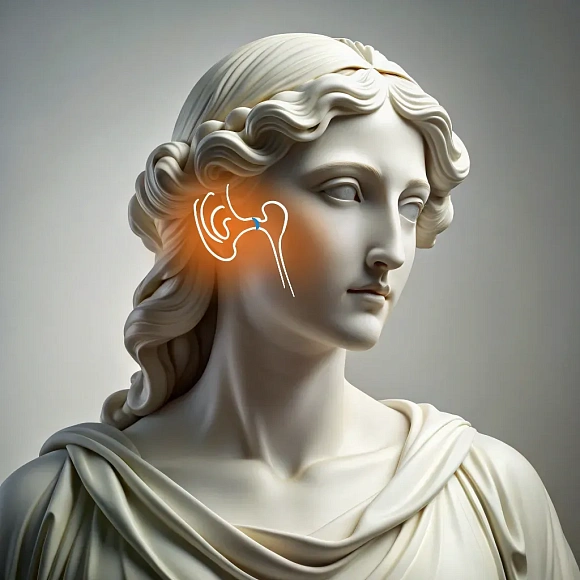
Perforation of the eardrum can occur as a result of chronic infections or injuries and lead to hearing impairment and an increased risk of middle ear infections. Symptoms of perforation: hearing loss, pain, discharge from the ear and a feeling of noise.
The restoration of the eardrum helps to improve auditory function and protect the middle ear from infections. Myringoplasty is indicated for perforations that do not heal on their own for several months.
Before rhinoplasty, it is necessary to consult with an otorhinolaryngologist and an anesthesiologist Perform general blood and urine tests Perform audiometry to assess auditory function To do a CT scan of the temporal bones
The operation is performed under general anesthesia. Depending on the volume of the intervention, the operation is performed either through the ear canal under the control of endoscopy, or through an incision behind the ear to access the eardrum (in some difficult cases). Then a graft is used, which is most often the patient's own tissue, for example, fascia or cartilage of the tragus of the auricle, which is placed on the perforation to close it. The graft is fixed with special tampons, which the patient wears for a month.
Myringoplasty is performed using: Surgical instruments (scalpels, forceps) Operating microscope for visualization Synthetic or autologous materials for defect closure
After surgery, patients are advised to avoid water entering the ear canal, physical exertion and weight lifting for several weeks. Antibiotics may also be prescribed to prevent infections.
Benefits
Hearing restoration
The procedure improves auditory function by restoring the integrity of the eardrum.
Preventing infections
Myringoplasty reduces the risk of infections in the middle ear.
Minimal invasiveness
The procedure is performed with minimal incisions and requires a short recovery period.
Long-term result
The restored eardrum provides a stable and long-lasting effect.
Врачи
Смотреть всех врачейSimilar referral activities
Anemia of the nasal cavity
Medical manipulation aimed at reducing blood flow in the nasal mucosa to reduce swelling and facilitate breathing.
Administration of drugs into the nasal cavity
One of the treatment methods that allows direct delivery of medicinal substances into the nasal cavity to combat infections, inflammation, allergies and other diseases of the nose and nasopharynx.
Video endoscopy
A detailed examination of the patient's upper respiratory tract during sleep in order to identify the cause of snoring, the severity of obstructive sleep apnea syndrome and to resolve the issue of long-range treatment tactics.
Opening of an ear abscess
A procedure aimed at removing pus from the ear tissues. It is required in the presence of an abscess — a formation with purulent contents.
Autopsy of an auricle hematoma
Removal of accumulated blood from under the skin of the auricle for pain relief and proper restoration of the shape of the ear.
Opening of purulent formations
A procedure to ensure drainage of the infected area to alleviate symptoms and prevent the spread of infection.
News & Media
Today, this day is dedicated all over the world to the phenomenon of the human voice and taking care of the health of the vocal apparatus.
Can sealing the mouth lead to suffocation? What other dangers might arise? The answers to these and other questions are waiting for you in the article.
Drug-induced rhinitis (as a form of vasomotor rhinitis) is a non-specific inflammation of the nasal mucosa due to excessive use of vasoconstrictor drugs containing xylometazoline, oxymetazoline, phenylephrine or naphazoline.
Walking in windy weather, getting water in your ear while swimming, or ARVI can cause ear pain. It is not always possible to immediately consult a doctor, and it is not easy to tolerate ear pain, especially when it is acute. In the article we will tell you about ear diseases and how to treat them.
One of the common reasons for visiting an otorhinolaryngologist is problems with nasal breathing. In this article, we will tell you what to do if your sense of smell has decreased, how to relieve nasal congestion and when to visit a doctor.
Pain can be felt when talking, laughing, swallowing, or even at rest. It is important to start treatment immediately, not to tolerate discomfort, so as not to start the disease and quickly get in shape. Ideally, take a sick leave to give the body time to recover and not infect colleagues. In the article we will tell you how to treat a sore throat.
How to reach


- Route from exit 4 of the «Belorusskaya» metro station
- Route from exit 2 of the «Belorusskaya» metro station
How to get
From the Belorusskaya metro station of the Zamoskvoretskaya line - exit 4 After exiting the subway, walk through the pedestrian tunnel and climb the stairs. Move towards the railway tracks, go down the stairs immediately after them and walk along the house, then turn right onto 1st Yamskoye Pole Street. At the turn to 3rd Yamsky Pole Street, cross the road at the pedestrian crossing and continue along 1st Yamsky Field Street, after a few buildings on the left you will see Olympus Clinic MARS.
Travel time
9 minutes
Landmark
Olympus Clinic MARS sign
How to get
From the Belorusskaya metro station of the Ring line - exit 2. After exiting the subway, turn left and walk to the pedestrian crossing. Cross the road through two pedestrian crossings and move along the Tverskoy overpass. Go down the stairs immediately after the railway tracks, walk along the house, then turn right onto 1st Yamskoye Pole Street. At the turn to 3rd Yamsky Pole Street, cross the road at the pedestrian crossing and continue along 1st Yamsky Field Street, after a few buildings on the left you will see Olympus Clinic MARS
Travel time
11 minutes
Landmark
Olympus Clinic MARS sign
Parking lot map
Exit 3 from the metro and 640 meters straight ahead, the clinic will be on the right. Landmark - sign Olymp Clinic
- Route from the «Sukharevskaya» metro station
- Route from the «Tsvetnoy Boulevard» metro station
From the metro station "Tsvetnoy Bulvar"
1 exit to the city, then left to the Garden Ring, at the crossing to the right, crossing the boulevard, one more crossing and at the traffic light to the left. The Olymp Clinic building is located overlooking the Garden Ring to the right of the crossing. Travel time is approximately 9 minutes. Landmark - sign Olymp Clini
From the metro station "Sukharevskaya"
Exit 3 from the metro and 640 meters straight ahead, the clinic will be on the right. Landmark - sign Olymp Clinic
Parking lot map
Exit 3 from the metro and 640 meters straight ahead, the clinic will be on the right. Landmark - sign Olymp Clinic
- The route from the «Airport» metro station
- Route from the «Sokol» metro station
From Sokol metro station
The last car from the center: follow the signs for Exit 5. From the glass doors to the right and go to the end of the passage. Exit to the city by the steps to the left. After exiting the crossing to the street, go straight along Leningradsky Prospekt to the intersection with Chapaevsky Lane. Next, turn right (onto Chapaevsky Lane) and walk to the Triumph Palace residential complex. Entrance to the territory: through checkpoint No. 1, opposite the Vkusville store, you will need to present your passport. After passing through the checkpoint, go up the stairs to the fountain, opposite it you will see our clinic.
Travel time
10-12 minutes
From the Airport metro station
The first car from the center: follow the Exit 2-3 signs. Turn left out of the glass doors and walk to the end of the passage. After exiting the crossing to the street, go straight along Leningradsky Prospekt to the intersection with Chapaevsky Lane. Next, turn left (onto Chapaevsky Lane) and walk to the Triumph Palace residential complex. Entrance to the territory: through checkpoint No. 1, opposite the Vkusville store, you will need to present your passport. After passing through the checkpoint, go up the stairs to the fountain, opposite it you will see our clinic.
Travel time
12-15 minutes
How to get
Entry to the territory is prohibited, but there are free city parking lots around the Triumph Palace residential complex, where you can easily find a place for your car.
- Route from exit 4 of the «Belorusskaya» metro station
- Route from exit 2 of the «Belorusskaya» metro station
How to get
From the Belorusskaya metro station of the Zamoskvoretskaya line - exit 4 After exiting the subway, walk through the pedestrian tunnel and climb the stairs. Move towards the railway tracks, go down the stairs immediately after them and walk along the house, then turn right onto 1st Yamskoye Pole Street. At the turn to 3rd Yamsky Pole Street, cross the road at the pedestrian crossing and continue along 1st Yamsky Field Street, after a few buildings on the left you will see Olympus Clinic MARS.
Travel time
9 minutes
Landmark
Olympus Clinic MARS sign
How to get
From the Belorusskaya metro station of the Ring line - exit 2. After exiting the subway, turn left and walk to the pedestrian crossing. Cross the road through two pedestrian crossings and move along the Tverskoy overpass. Go down the stairs immediately after the railway tracks, walk along the house, then turn right onto 1st Yamskoye Pole Street. At the turn to 3rd Yamsky Pole Street, cross the road at the pedestrian crossing and continue along 1st Yamsky Field Street, after a few buildings on the left you will see Olympus Clinic MARS
Travel time
11 minutes
Landmark
Olympus Clinic MARS sign
Parking lot map
Exit 3 from the metro and 640 meters straight ahead, the clinic will be on the right. Landmark - sign Olymp Clinic