




Lower jaw osteosynthesis
A surgical procedure designed to repair broken bones in cases of mandibular fractures.
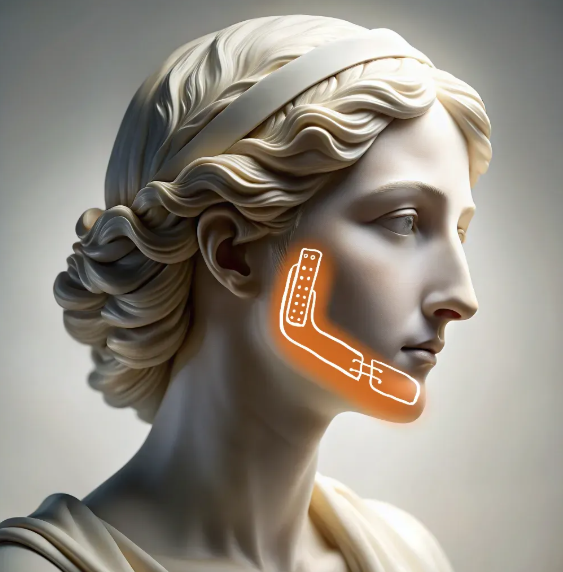
In cases of mandibular fractures, it is essential to restore the bone to its anatomical shape and ensure its immobility for proper healing. Traditional treatment methods, including splinting, may not always ensure stable fixation, particularly in complicated or multiple fractures. Such cases often require osteosynthesis, a surgical procedure in which bone fragments are fixed with miniplates and screws
Osteosynthesis involves aligning bone fragments and eliminating displacement, which is important for restoring bite and chewing function. This technique is used for fresh fractures, as well as for old or improperly healed injuries, and in reconstructive surgery.
Prior to osteosynthesis, an X-ray or CT scan of the jaw is performed to assess the location of the fragments. Prescribed laboratory tests include a complete blood count, biochemical analysis, coagulogram, infection tests, and a complete urine test. An ECG and fluorography are also performed.
The procedure is performed under either general or local anesthesia, based on the location of the fracture and the patient's condition. The surgeon will access the fracture site through the oral cavity. Fragments are then repositioned and fixed with titanium plates, screws, or pins. The type of osteosynthesis is selected individually, including focal or extrafocal fixation, open or closed, based on the specific needs of each patient.
We use advanced equipment, including titanium mini-plates, screws, and pins, as well as surgical navigation and intraoperative fragment position control.
The patient stays in the hospital for up to three days after the surgery. In the first few days, it is necessary to rest, avoid straining the jaw, and only consume liquid foods. Antibiotics, painkillers, and anti-inflammatory drugs are prescribed. Physiotherapy starts on the second week, followed by exercise therapy in 3–5 weeks. Full recovery takes one to three months.
Benefits
Anatomical repositioning
Restores the correct shape of the jaw and prevents deformities.
Repeat injury prevention
Secure fixation prevents displacement of fragments during healing.
Rapid function recovery
Promotes a return to normal eating, speech, and facial expressions.
Complex fractures treatment
Suitable for treating multiple and improperly healed fractures.
Frequently Asked Questions
How long does the surgery take?
How painful is the surgery and recovery?
How soon can I go back to eating normally?
Didn't find an answer to your question?
You can describe your problem in detail and ask a question to the doctor. He will answer you and help you find a solution
Врачи
Смотреть всех врачей
Maxillofacial surgeon. Candidate of Medical Sciences.
Similar referral activities
Post-traumatic facial deformities treatment
Surgical restoration of facial bones and soft tissues after trauma to restore function and appearance.
Maxillofacial purulent inflammations diagnostics and dissection
Surgical treatment of abscesses, phlegmons, and other acute inflammations with drainage and sanitation.
Facial and neck surgical wound treatment
Primary surgical treatment and soft tissue plasty aimed at preventing complications and accelerating healing.
Naso-orbital reduction and osteosynthesis
Facial skeleton restoration surgery involving nose and eye socket fractures.
Cheekbone reduction and osteosynthesis
Surgical restoration of the zygomatic bone using titanium plates to fix the fragments.
How to reach


- Route from exit 4 of the «Belorusskaya» metro station
- Route from exit 2 of the «Belorusskaya» metro station
How to get
From the Belorusskaya metro station of the Zamoskvoretskaya line - exit 4 After exiting the subway, walk through the pedestrian tunnel and climb the stairs. Move towards the railway tracks, go down the stairs immediately after them and walk along the house, then turn right onto 1st Yamskoye Pole Street. At the turn to 3rd Yamsky Pole Street, cross the road at the pedestrian crossing and continue along 1st Yamsky Field Street, after a few buildings on the left you will see Olympus Clinic MARS.
Travel time
9 minutes
Landmark
Olympus Clinic MARS sign
How to get
From the Belorusskaya metro station of the Ring line - exit 2. After exiting the subway, turn left and walk to the pedestrian crossing. Cross the road through two pedestrian crossings and move along the Tverskoy overpass. Go down the stairs immediately after the railway tracks, walk along the house, then turn right onto 1st Yamskoye Pole Street. At the turn to 3rd Yamsky Pole Street, cross the road at the pedestrian crossing and continue along 1st Yamsky Field Street, after a few buildings on the left you will see Olympus Clinic MARS
Travel time
11 minutes
Landmark
Olympus Clinic MARS sign
Parking lot map
Exit 3 from the metro and 640 meters straight ahead, the clinic will be on the right. Landmark - sign Olymp Clinic
- Route from the «Sukharevskaya» metro station
- Route from the «Tsvetnoy Boulevard» metro station
From the metro station "Tsvetnoy Bulvar"
1 exit to the city, then left to the Garden Ring, at the crossing to the right, crossing the boulevard, one more crossing and at the traffic light to the left. The Olymp Clinic building is located overlooking the Garden Ring to the right of the crossing. Travel time is approximately 9 minutes. Landmark - sign Olymp Clini
From the metro station "Sukharevskaya"
Exit 3 from the metro and 640 meters straight ahead, the clinic will be on the right. Landmark - sign Olymp Clinic
Parking lot map
Exit 3 from the metro and 640 meters straight ahead, the clinic will be on the right. Landmark - sign Olymp Clinic
- The route from the «Airport» metro station
- Route from the «Sokol» metro station
From Sokol metro station
The last car from the center: follow the signs for Exit 5. From the glass doors to the right and go to the end of the passage. Exit to the city by the steps to the left. After exiting the crossing to the street, go straight along Leningradsky Prospekt to the intersection with Chapaevsky Lane. Next, turn right (onto Chapaevsky Lane) and walk to the Triumph Palace residential complex. Entrance to the territory: through checkpoint No. 1, opposite the Vkusville store, you will need to present your passport. After passing through the checkpoint, go up the stairs to the fountain, opposite it you will see our clinic.
Travel time
10-12 minutes
From the Airport metro station
The first car from the center: follow the Exit 2-3 signs. Turn left out of the glass doors and walk to the end of the passage. After exiting the crossing to the street, go straight along Leningradsky Prospekt to the intersection with Chapaevsky Lane. Next, turn left (onto Chapaevsky Lane) and walk to the Triumph Palace residential complex. Entrance to the territory: through checkpoint No. 1, opposite the Vkusville store, you will need to present your passport. After passing through the checkpoint, go up the stairs to the fountain, opposite it you will see our clinic.
Travel time
12-15 minutes
How to get
Entry to the territory is prohibited, but there are free city parking lots around the Triumph Palace residential complex, where you can easily find a place for your car.
- Route from exit 4 of the «Belorusskaya» metro station
- Route from exit 2 of the «Belorusskaya» metro station
How to get
From the Belorusskaya metro station of the Zamoskvoretskaya line - exit 4 After exiting the subway, walk through the pedestrian tunnel and climb the stairs. Move towards the railway tracks, go down the stairs immediately after them and walk along the house, then turn right onto 1st Yamskoye Pole Street. At the turn to 3rd Yamsky Pole Street, cross the road at the pedestrian crossing and continue along 1st Yamsky Field Street, after a few buildings on the left you will see Olympus Clinic MARS.
Travel time
9 minutes
Landmark
Olympus Clinic MARS sign
How to get
From the Belorusskaya metro station of the Ring line - exit 2. After exiting the subway, turn left and walk to the pedestrian crossing. Cross the road through two pedestrian crossings and move along the Tverskoy overpass. Go down the stairs immediately after the railway tracks, walk along the house, then turn right onto 1st Yamskoye Pole Street. At the turn to 3rd Yamsky Pole Street, cross the road at the pedestrian crossing and continue along 1st Yamsky Field Street, after a few buildings on the left you will see Olympus Clinic MARS
Travel time
11 minutes
Landmark
Olympus Clinic MARS sign
Parking lot map
Exit 3 from the metro and 640 meters straight ahead, the clinic will be on the right. Landmark - sign Olymp Clinic