




Lumbar puncture
Minimally invasive sampling of cerebrospinal fluid to study its composition in order to identify the causes of diseases of the nervous system.
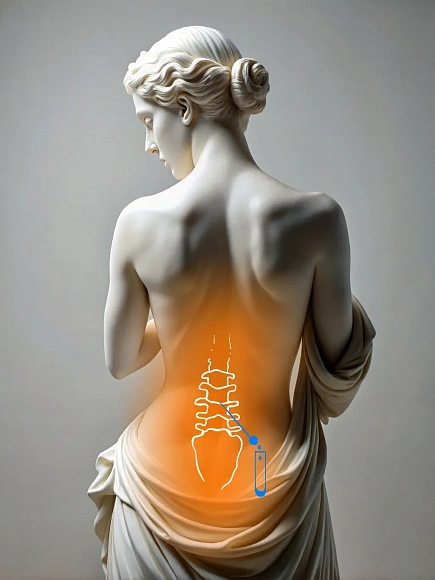
A lumbar puncture is an invasive diagnostic procedure in which a doctor uses a special needle to obtain a sample of cerebrospinal fluid (CSF) for analysis.
Cerebrospinal fluid is a biological fluid that washes the brain and spinal cord, performing protective, shock–absorbing and transport functions. Changes in its composition may indicate the presence of infectious, inflammatory, autoimmune or tumor diseases of the nervous system. The procedure is performed both for diagnostic purposes – to identify pathologies such as meningitis, encephalitis, multiple sclerosis, neuroinfections, CNS tumors, and for therapeutic purposes – to reduce intracranial pressure or administer medications.
Before the lumbar puncture, the patient undergoes a standard examination, including a general blood test, a coagulogram (blood clotting test) and, if necessary, neuroimaging (CT or MRI of the brain) to exclude contraindications. On the day of the procedure, it is recommended not to eat fatty and heavy foods, as well as drink enough fluids.
The patient is positioned on a couch, lying on his side with bent knees pulled up to his chest, or sitting, leaning forward as much as possible. The doctor determines the optimal point for inserting the needle into the intervertebral space, then performs local anesthesia and inserts a thin needle that penetrates into the subarachnoid space where the cerebrospinal fluid circulates. When it gets into the desired area, a slow outflow of liquid begins, which is collected in test tubes for further laboratory analysis. The whole manipulation takes about 30-40 minutes.
Процедура проводится с использованием современных атравматичных спинальных одноразовых игл, резко снижающих риск побочных эффектов в виде головной боли. Также применяются пробирки с герметичными крышками для безопасного забора и транспортировки ликвора в лабораторию.
After a lumbar puncture, it is important to stay in a horizontal position for the first 30-40 minutes, avoiding sudden movements and lifting the head. During the day, it is recommended to limit physical activity, drink enough water and, if necessary, take painkillers prescribed by a doctor. Some patients may experience headaches after a puncture, which is a normal reaction of the body to a slight decrease in cerebrospinal fluid pressure. The symptoms usually go away within a few days.
Benefits
High diagnostic accuracy
It helps to identify infections, inflammatory and oncological diseases of the nervous system.
Minimally invasive technique
Modern needles reduce the painfulness of the procedure.
The possibility of therapeutic effects
Modern needles reduce the painfulness of the procedure.A puncture can reduce intracranial pressure or administer medications.
Safety
The procedure is performed by qualified doctors in compliance with all sterility measures.
Врачи
Смотреть всех врачейSimilar referral activities
Botulinum therapy for neurological diseases
This is a treatment method based on the injection of botulinum toxin type A into certain muscles to temporarily block nerve impulses, reduce muscle spasms and relieve pain.
Headache Treatment
An individual approach to the treatment of headaches, aimed at eliminating symptoms and identifying the root cause.
Migraine Treatment
Treatment aimed at reducing the frequency and intensity of migraine attacks. It may include drug therapy, behavioral and cognitive techniques, as well as recommendations for lifestyle and nutrition changes.
Neurologist's appointment
Specialists diagnose neurological symptoms. Among the disorders of NS, it is customary to distinguish several groups of clinical signs — pain syndrome, motor and/or sensory disorders, coordination disorders, pelvic disorders and general symptoms.
Ultrasound of peripheral nerves
A diagnostic method that allows you to assess the condition of nerve trunks and identify pathological changes that disrupt the conduction of nerve impulses.
News & Media
Our hands are constantly in motion—we type, swipe through smartphone screens, tie shoelaces, and perform hundreds of other actions. But what if at one point it all starts to hurt? This discomfort may signal the development of tunnel syndrome. Today, this problem is known as the "office employee disease," although its victims are not only those who work a lot at the computer.
Sleep disorders are when you can't fall asleep even if you want to, or can't sleep long enough. Many people experience short-term (acute) insomnia that lasts for a few days or weeks (but less than 3 months). It is usually the result of stress or a traumatic event. Chronic insomnia lasts at least three nights a week for three months or more. The causes in this case are more profound. Now we will tell you why insomnia occurs and how to treat the sleep disorder.
How to reach


- Route from exit 4 of the «Belorusskaya» metro station
- Route from exit 2 of the «Belorusskaya» metro station
How to get
From the Belorusskaya metro station of the Zamoskvoretskaya line - exit 4 After exiting the subway, walk through the pedestrian tunnel and climb the stairs. Move towards the railway tracks, go down the stairs immediately after them and walk along the house, then turn right onto 1st Yamskoye Pole Street. At the turn to 3rd Yamsky Pole Street, cross the road at the pedestrian crossing and continue along 1st Yamsky Field Street, after a few buildings on the left you will see Olympus Clinic MARS.
Travel time
9 minutes
Landmark
Olympus Clinic MARS sign
How to get
From the Belorusskaya metro station of the Ring line - exit 2. After exiting the subway, turn left and walk to the pedestrian crossing. Cross the road through two pedestrian crossings and move along the Tverskoy overpass. Go down the stairs immediately after the railway tracks, walk along the house, then turn right onto 1st Yamskoye Pole Street. At the turn to 3rd Yamsky Pole Street, cross the road at the pedestrian crossing and continue along 1st Yamsky Field Street, after a few buildings on the left you will see Olympus Clinic MARS
Travel time
11 minutes
Landmark
Olympus Clinic MARS sign
Parking lot map
Exit 3 from the metro and 640 meters straight ahead, the clinic will be on the right. Landmark - sign Olymp Clinic
- Route from the «Sukharevskaya» metro station
- Route from the «Tsvetnoy Boulevard» metro station
From the metro station "Tsvetnoy Bulvar"
1 exit to the city, then left to the Garden Ring, at the crossing to the right, crossing the boulevard, one more crossing and at the traffic light to the left. The Olymp Clinic building is located overlooking the Garden Ring to the right of the crossing. Travel time is approximately 9 minutes. Landmark - sign Olymp Clini
From the metro station "Sukharevskaya"
Exit 3 from the metro and 640 meters straight ahead, the clinic will be on the right. Landmark - sign Olymp Clinic
Parking lot map
Exit 3 from the metro and 640 meters straight ahead, the clinic will be on the right. Landmark - sign Olymp Clinic
- The route from the «Airport» metro station
- Route from the «Sokol» metro station
From Sokol metro station
The last car from the center: follow the signs for Exit 5. From the glass doors to the right and go to the end of the passage. Exit to the city by the steps to the left. After exiting the crossing to the street, go straight along Leningradsky Prospekt to the intersection with Chapaevsky Lane. Next, turn right (onto Chapaevsky Lane) and walk to the Triumph Palace residential complex. Entrance to the territory: through checkpoint No. 1, opposite the Vkusville store, you will need to present your passport. After passing through the checkpoint, go up the stairs to the fountain, opposite it you will see our clinic.
Travel time
10-12 minutes
From the Airport metro station
The first car from the center: follow the Exit 2-3 signs. Turn left out of the glass doors and walk to the end of the passage. After exiting the crossing to the street, go straight along Leningradsky Prospekt to the intersection with Chapaevsky Lane. Next, turn left (onto Chapaevsky Lane) and walk to the Triumph Palace residential complex. Entrance to the territory: through checkpoint No. 1, opposite the Vkusville store, you will need to present your passport. After passing through the checkpoint, go up the stairs to the fountain, opposite it you will see our clinic.
Travel time
12-15 minutes
How to get
Entry to the territory is prohibited, but there are free city parking lots around the Triumph Palace residential complex, where you can easily find a place for your car.
- Route from exit 4 of the «Belorusskaya» metro station
- Route from exit 2 of the «Belorusskaya» metro station
How to get
From the Belorusskaya metro station of the Zamoskvoretskaya line - exit 4 After exiting the subway, walk through the pedestrian tunnel and climb the stairs. Move towards the railway tracks, go down the stairs immediately after them and walk along the house, then turn right onto 1st Yamskoye Pole Street. At the turn to 3rd Yamsky Pole Street, cross the road at the pedestrian crossing and continue along 1st Yamsky Field Street, after a few buildings on the left you will see Olympus Clinic MARS.
Travel time
9 minutes
Landmark
Olympus Clinic MARS sign
How to get
From the Belorusskaya metro station of the Ring line - exit 2. After exiting the subway, turn left and walk to the pedestrian crossing. Cross the road through two pedestrian crossings and move along the Tverskoy overpass. Go down the stairs immediately after the railway tracks, walk along the house, then turn right onto 1st Yamskoye Pole Street. At the turn to 3rd Yamsky Pole Street, cross the road at the pedestrian crossing and continue along 1st Yamsky Field Street, after a few buildings on the left you will see Olympus Clinic MARS
Travel time
11 minutes
Landmark
Olympus Clinic MARS sign
Parking lot map
Exit 3 from the metro and 640 meters straight ahead, the clinic will be on the right. Landmark - sign Olymp Clinic