




Pediatric abdominal ultrasound
Pediatric abdominal ultrasound is a safe, accurate and painless diagnostic examination of internal organs: the liver, gallbladder, pancreas, spleen, intestines, lymph nodes, and abdominal aorta.
For 2-3 days prior to the examination, children should avoid gassy foods, such as cabbage, legumes, fresh fruit, dairy products, sweets, and carbonated drinks. They should have a light dinner the day before the examination, no later than 6-7 p.m. On the day of the procedure, they should not eat or drink anything for 6-8 hours before the ultrasound, including water. If your child is prone to bloating, a physician may recommend enterosorbents or carminative drugs.
The child is positioned on a couch, and a special gel is applied to the abdomen to enhance the transmission of ultrasound waves. A diagnostician carefully moves the sensor over the target area, examining internal organs in real time. The patient may need to change their position during the examination. The procedure usually takes 20-30 minutes and doesn't cause discomfort.
We use a high-frequency digital ultrasound machine. This lets us get a clear picture of small structures. This is especially important when examining younger children, whose organs are still developing and need to be assessed with high accuracy.
Children can return to their regular activities immediately after the procedure. Ultrasound does not require recovery. You receive a medical conclusion either immediately after the procedure or within a few hours.
Benefits
Safety
Suitable for children of all ages, including newborns.
Accuracy
Helps identify pathologies at an early stage, before symptoms appear.
Comfort
The procedure is non-invasive and painless.
Speed
The results can be obtained immediately after the examination.
Врачи
Смотреть всех врачей

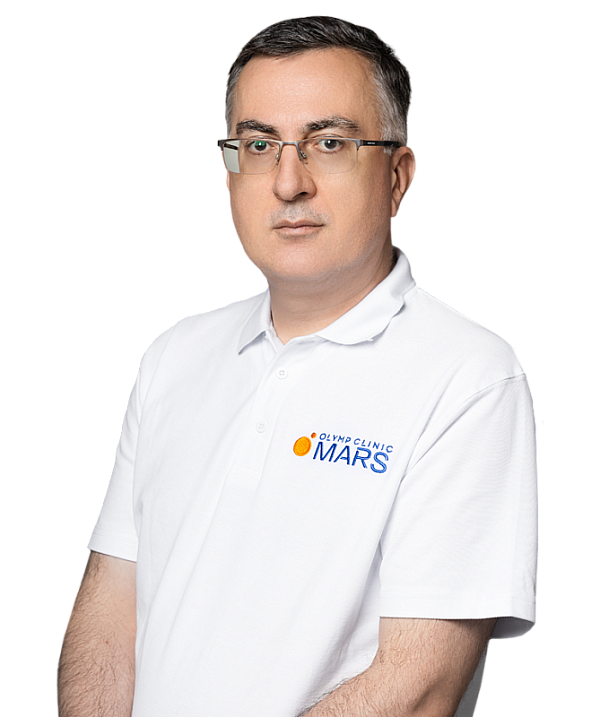
Ultrasound Diagnostician, Candidate of Medical Sciences, Higher Qualifying Category Physician.
Indications and contraindications
Indications
Abdominal distension, stool disorders, poor appetite
Fever
Suspected appendicitis, cholecystitis, pancreatitis
Enlargement of the abdomen or individual organs detected during examination
Abdominal trauma
Monitoring of chronic diseases of the liver, pancreas, and biliary tract
Similar referral activities
Pediatric musculoskeletal ultrasound
Pediatric musculoskeletal ultrasound examines the musculoskeletal system in children using ultrasound waves to assess the condition of muscles, tendons, joints, and bone surfaces. It is used to detect injuries, inflammation, ligament tears, and minor fractures that may not be visible on X-rays.
Pediatric breast ultrasound
Pediatric breast ultrasound is a non-invasive diagnostic procedure used to assess the structure of breast tissue and detect potential abnormalities such as inflammation, cysts, and tumors. It is a safe and radiation-free method based on the use of ultrasound waves, making it suitable even for the youngest patients.
Pediatric joint ultrasound
Joint ultrasound is a non-invasive diagnostic procedure used to obtain detailed assessment of periarticular structures, including cartilage, ligaments, tendons, and soft tissues. It is particularly relevant in children, as mobility and active growth may be accompanied by pain and injuries.
Pediatric thyroid ultrasound
Pediatric thyroid ultrasound is a safe and painless diagnostic procedure that helps assess the structure, size, and blood supply of a child's thyroid gland. The examination helps identify congenital anomalies, thyroiditis, cysts, tumors, and other pathologies at the earliest stages.
Pediatric peripheral nerve ultrasound
Peripheral nerve ultrasound is a safe way to assess the nervous system, helping identify various pathological changes that disrupt the conduction of nerve impulses. This method helps diagnose inflammation and trauma in nervous system dysfunction in children.
Pediatric pelvic ultrasound
Pelvic ultrasound is a safe and highly informative imaging of internal organs of the pelvis in children. This examination helps assess the state of the bladder, uterus and ovaries in girls, as well as the prostate gland and seminal vesicles in boys.
How to reach


- Route from exit 4 of the «Belorusskaya» metro station
- Route from exit 2 of the «Belorusskaya» metro station
How to get
From the Belorusskaya metro station of the Zamoskvoretskaya line - exit 4 After exiting the subway, walk through the pedestrian tunnel and climb the stairs. Move towards the railway tracks, go down the stairs immediately after them and walk along the house, then turn right onto 1st Yamskoye Pole Street. At the turn to 3rd Yamsky Pole Street, cross the road at the pedestrian crossing and continue along 1st Yamsky Field Street, after a few buildings on the left you will see Olympus Clinic MARS.
Travel time
9 minutes
Landmark
Olympus Clinic MARS sign
How to get
From the Belorusskaya metro station of the Ring line - exit 2. After exiting the subway, turn left and walk to the pedestrian crossing. Cross the road through two pedestrian crossings and move along the Tverskoy overpass. Go down the stairs immediately after the railway tracks, walk along the house, then turn right onto 1st Yamskoye Pole Street. At the turn to 3rd Yamsky Pole Street, cross the road at the pedestrian crossing and continue along 1st Yamsky Field Street, after a few buildings on the left you will see Olympus Clinic MARS
Travel time
11 minutes
Landmark
Olympus Clinic MARS sign
Parking lot map
Exit 3 from the metro and 640 meters straight ahead, the clinic will be on the right. Landmark - sign Olymp Clinic
- Route from the «Sukharevskaya» metro station
- Route from the «Tsvetnoy Boulevard» metro station
From the metro station "Tsvetnoy Bulvar"
1 exit to the city, then left to the Garden Ring, at the crossing to the right, crossing the boulevard, one more crossing and at the traffic light to the left. The Olymp Clinic building is located overlooking the Garden Ring to the right of the crossing. Travel time is approximately 9 minutes. Landmark - sign Olymp Clini
From the metro station "Sukharevskaya"
Exit 3 from the metro and 640 meters straight ahead, the clinic will be on the right. Landmark - sign Olymp Clinic
Parking lot map
Exit 3 from the metro and 640 meters straight ahead, the clinic will be on the right. Landmark - sign Olymp Clinic
- The route from the «Airport» metro station
- Route from the «Sokol» metro station
From Sokol metro station
The last car from the center: follow the signs for Exit 5. From the glass doors to the right and go to the end of the passage. Exit to the city by the steps to the left. After exiting the crossing to the street, go straight along Leningradsky Prospekt to the intersection with Chapaevsky Lane. Next, turn right (onto Chapaevsky Lane) and walk to the Triumph Palace residential complex. Entrance to the territory: through checkpoint No. 1, opposite the Vkusville store, you will need to present your passport. After passing through the checkpoint, go up the stairs to the fountain, opposite it you will see our clinic.
Travel time
10-12 minutes
From the Airport metro station
The first car from the center: follow the Exit 2-3 signs. Turn left out of the glass doors and walk to the end of the passage. After exiting the crossing to the street, go straight along Leningradsky Prospekt to the intersection with Chapaevsky Lane. Next, turn left (onto Chapaevsky Lane) and walk to the Triumph Palace residential complex. Entrance to the territory: through checkpoint No. 1, opposite the Vkusville store, you will need to present your passport. After passing through the checkpoint, go up the stairs to the fountain, opposite it you will see our clinic.
Travel time
12-15 minutes
How to get
Entry to the territory is prohibited, but there are free city parking lots around the Triumph Palace residential complex, where you can easily find a place for your car.
- Route from exit 4 of the «Belorusskaya» metro station
- Route from exit 2 of the «Belorusskaya» metro station
How to get
From the Belorusskaya metro station of the Zamoskvoretskaya line - exit 4 After exiting the subway, walk through the pedestrian tunnel and climb the stairs. Move towards the railway tracks, go down the stairs immediately after them and walk along the house, then turn right onto 1st Yamskoye Pole Street. At the turn to 3rd Yamsky Pole Street, cross the road at the pedestrian crossing and continue along 1st Yamsky Field Street, after a few buildings on the left you will see Olympus Clinic MARS.
Travel time
9 minutes
Landmark
Olympus Clinic MARS sign
How to get
From the Belorusskaya metro station of the Ring line - exit 2. After exiting the subway, turn left and walk to the pedestrian crossing. Cross the road through two pedestrian crossings and move along the Tverskoy overpass. Go down the stairs immediately after the railway tracks, walk along the house, then turn right onto 1st Yamskoye Pole Street. At the turn to 3rd Yamsky Pole Street, cross the road at the pedestrian crossing and continue along 1st Yamsky Field Street, after a few buildings on the left you will see Olympus Clinic MARS
Travel time
11 minutes
Landmark
Olympus Clinic MARS sign
Parking lot map
Exit 3 from the metro and 640 meters straight ahead, the clinic will be on the right. Landmark - sign Olymp Clinic