

Dermatologist's appointment
Skin, hair, or nail problems? A dermatologist will prescribe a diagnosis, as well as draw up a treatment or prevention plan for dermatological problems.

Кожа — это важный и самый большой орган человека, который может подвергаться различным заболеваниям, включая аллергодерматозы, иммуновоспалительные дерматозы, кожные патологии инфекционной природы и другие.
Дерматологи специализируются на лечении таких заболеваний, как акне, атопический дерматит, красный плоский лишай, псориаз, склеродермия, экзема, грибковые инфекции, алопеция и многих других, а также проводят диагностику и удаление доброкачественных новообразований кожи. На консультации будет разработана стратегия лечения, направленная на устранение симптомов, предотвращение рецидивов и поддержание здоровья кожи.
Before consulting a dermatologist, it is recommended to bring the results of previous examinations, if any. Ask your relatives if there have been any cases of skin diseases or skin cancer (melanoma, basal cell carcinoma) in the family. Prepare a description of the symptoms: their duration, intensity, and possible triggers. Tell your doctor how long ago the rashes appeared, where they first appeared, what sensations accompany the symptoms, and whether relatives have similar manifestations. Also, specify which skin, hair, or nail care products you use. If the complaint is related to the condition of the hair, do not wash your hair before taking it — it is optimal to do this 2-3 days before the consultation.
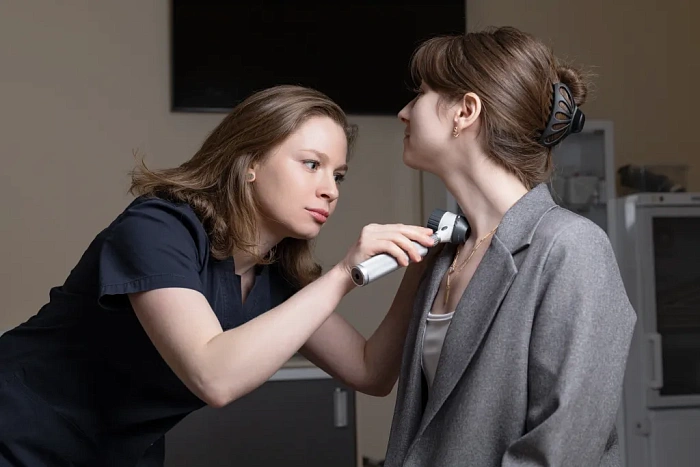
The consultation begins with interviewing the patient and examining the medical history, after which the doctor examines the skin of the entire body surface, hair and nails. Don't be surprised when a dermatologist asks you to undress completely for an examination. The doctor needs to fully assess the condition of your skin. A dermatologist can use a dermatoscope or a video dermatoscope to examine moles or other growths in detail. The doctor can also perform a luminescent diagnosis to determine fungal manifestations and inflammation. Depending on the symptoms, laboratory tests, biopsies, or allergy tests may be prescribed to clarify the diagnosis.
For diagnosis, the dermatologist uses a dermatoscope to examine skin growths and laboratory equipment to perform blood and skin tests.
The patient receives personal recommendations on treatment and skin care. Regular checkups help to monitor the dynamics of treatment and adjust therapy on time.
Benefits
Accurate diagnosis
Modern methods make it possible to detect skin diseases at an early stage.
An integrated approach
Selection of therapy based on the individual characteristics of the patient.
Improving the appearance of the skin
Restoring a healthy skin appearance, reducing the appearance of scars or age spots.
Prevention of complications
Timely treatment helps to avoid the transition of the disease to a chronic form.
Preparation
Before consulting a dermatologist, it is recommended to bring the results of previous examinations, if any. Ask your relatives if there have been any cases of skin diseases or skin cancer (melanoma, basal cell carcinoma) in the family. Prepare a description of the symptoms: their duration, intensity, and possible triggers. Tell your doctor how long ago the rashes appeared, where they first appeared, what sensations accompany the symptoms, and whether relatives have similar manifestations. Also, specify which skin, hair, or nail care products you use. If the complaint is related to the condition of the hair, do not wash your hair before taking it — it is optimal to do this 2-3 days before the consultation.

Consultation
The consultation begins with interviewing the patient and examining the medical history, after which the doctor examines the skin of the entire body surface, hair and nails. Don't be surprised when a dermatologist asks you to undress completely for an examination. The doctor needs to fully assess the condition of your skin. A dermatologist can use a dermatoscope or a video dermatoscope to examine moles or other growths in detail. The doctor can also perform a luminescent diagnosis to determine fungal manifestations and inflammation. Depending on the symptoms, laboratory tests, biopsies, or allergy tests may be prescribed to clarify the diagnosis.
Recommendations
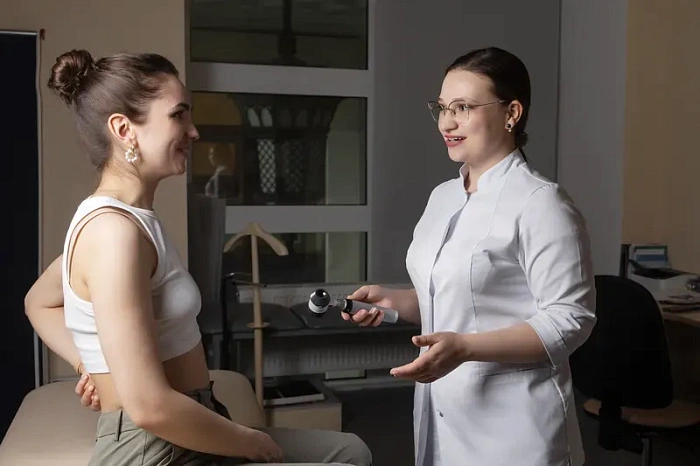
The patient receives personal recommendations on treatment and skin care. Regular checkups help to monitor the dynamics of treatment and adjust therapy on time.
Врачи
Смотреть всех врачейIndications and contraindications
Indications
Pathological changes in hair and nails
Increased hair loss or changes in the structure of nails.
Chronic itching or irritation
Symptoms that may indicate allergic reactions or internal diseases.
Changes in moles or the appearance of new formations on the skin
The need for evaluation and possible diagnosis of melanoma.
Skin problems such as acne, eczema, psoriasis
The presence of chronic or acute dermatological diseases.
Expected effect
Accurate diagnosis
Identification of the causes of skin problems, including through the examination of biopsy material.
Relief of symptoms
Reduction or complete elimination of discomfort, itching, irritation or inflammation.
Improving the appearance of the skin
Restoring a healthy skin appearance, reducing the visibility of scars or age spots.
Prevention of complications
Preventing the development of serious skin diseases and their complications, such as melanoma and psoriatic arthritis.
Similar referral activities
Dermatoscopy
A method for diagnosing skin neoplasms (moles, age spots, and others) using a dermatoscope, which enlarges the image of the skin and allows you to study the structure of neoplasms in detail.
Diagnosis and treatment of atopic dermatitis
Комплексный подход к диагностике и лечению атопического дерматита, включающий индивидуальный подбор схем терапии и уход за кожей.
How to reach


- Route from exit 4 of the «Belorusskaya» metro station
- Route from exit 2 of the «Belorusskaya» metro station
How to get
From the Belorusskaya metro station of the Zamoskvoretskaya line - exit 4 After exiting the subway, walk through the pedestrian tunnel and climb the stairs. Move towards the railway tracks, go down the stairs immediately after them and walk along the house, then turn right onto 1st Yamskoye Pole Street. At the turn to 3rd Yamsky Pole Street, cross the road at the pedestrian crossing and continue along 1st Yamsky Field Street, after a few buildings on the left you will see Olympus Clinic MARS.
Travel time
9 minutes
Landmark
Olympus Clinic MARS sign
How to get
From the Belorusskaya metro station of the Ring line - exit 2. After exiting the subway, turn left and walk to the pedestrian crossing. Cross the road through two pedestrian crossings and move along the Tverskoy overpass. Go down the stairs immediately after the railway tracks, walk along the house, then turn right onto 1st Yamskoye Pole Street. At the turn to 3rd Yamsky Pole Street, cross the road at the pedestrian crossing and continue along 1st Yamsky Field Street, after a few buildings on the left you will see Olympus Clinic MARS
Travel time
11 minutes
Landmark
Olympus Clinic MARS sign
Parking lot map
Exit 3 from the metro and 640 meters straight ahead, the clinic will be on the right. Landmark - sign Olymp Clinic
- Route from the «Sukharevskaya» metro station
- Route from the «Tsvetnoy Boulevard» metro station
From the metro station "Tsvetnoy Bulvar"
1 exit to the city, then left to the Garden Ring, at the crossing to the right, crossing the boulevard, one more crossing and at the traffic light to the left. The Olymp Clinic building is located overlooking the Garden Ring to the right of the crossing. Travel time is approximately 9 minutes. Landmark - sign Olymp Clini
From the metro station "Sukharevskaya"
Exit 3 from the metro and 640 meters straight ahead, the clinic will be on the right. Landmark - sign Olymp Clinic
Parking lot map
Exit 3 from the metro and 640 meters straight ahead, the clinic will be on the right. Landmark - sign Olymp Clinic
- The route from the «Airport» metro station
- Route from the «Sokol» metro station
From Sokol metro station
The last car from the center: follow the signs for Exit 5. From the glass doors to the right and go to the end of the passage. Exit to the city by the steps to the left. After exiting the crossing to the street, go straight along Leningradsky Prospekt to the intersection with Chapaevsky Lane. Next, turn right (onto Chapaevsky Lane) and walk to the Triumph Palace residential complex. Entrance to the territory: through checkpoint No. 1, opposite the Vkusville store, you will need to present your passport. After passing through the checkpoint, go up the stairs to the fountain, opposite it you will see our clinic.
Travel time
10-12 minutes
From the Airport metro station
The first car from the center: follow the Exit 2-3 signs. Turn left out of the glass doors and walk to the end of the passage. After exiting the crossing to the street, go straight along Leningradsky Prospekt to the intersection with Chapaevsky Lane. Next, turn left (onto Chapaevsky Lane) and walk to the Triumph Palace residential complex. Entrance to the territory: through checkpoint No. 1, opposite the Vkusville store, you will need to present your passport. After passing through the checkpoint, go up the stairs to the fountain, opposite it you will see our clinic.
Travel time
12-15 minutes
How to get
Entry to the territory is prohibited, but there are free city parking lots around the Triumph Palace residential complex, where you can easily find a place for your car.
- Route from exit 4 of the «Belorusskaya» metro station
- Route from exit 2 of the «Belorusskaya» metro station
How to get
From the Belorusskaya metro station of the Zamoskvoretskaya line - exit 4 After exiting the subway, walk through the pedestrian tunnel and climb the stairs. Move towards the railway tracks, go down the stairs immediately after them and walk along the house, then turn right onto 1st Yamskoye Pole Street. At the turn to 3rd Yamsky Pole Street, cross the road at the pedestrian crossing and continue along 1st Yamsky Field Street, after a few buildings on the left you will see Olympus Clinic MARS.
Travel time
9 minutes
Landmark
Olympus Clinic MARS sign
How to get
From the Belorusskaya metro station of the Ring line - exit 2. After exiting the subway, turn left and walk to the pedestrian crossing. Cross the road through two pedestrian crossings and move along the Tverskoy overpass. Go down the stairs immediately after the railway tracks, walk along the house, then turn right onto 1st Yamskoye Pole Street. At the turn to 3rd Yamsky Pole Street, cross the road at the pedestrian crossing and continue along 1st Yamsky Field Street, after a few buildings on the left you will see Olympus Clinic MARS
Travel time
11 minutes
Landmark
Olympus Clinic MARS sign
Parking lot map
Exit 3 from the metro and 640 meters straight ahead, the clinic will be on the right. Landmark - sign Olymp Clinic